John moves to Brighton
In a newspaper report published in 1860 John refers to having been living at Brighton for 22 years, which would place his move there from Heathfield around 1838, when he was in his mid teens.
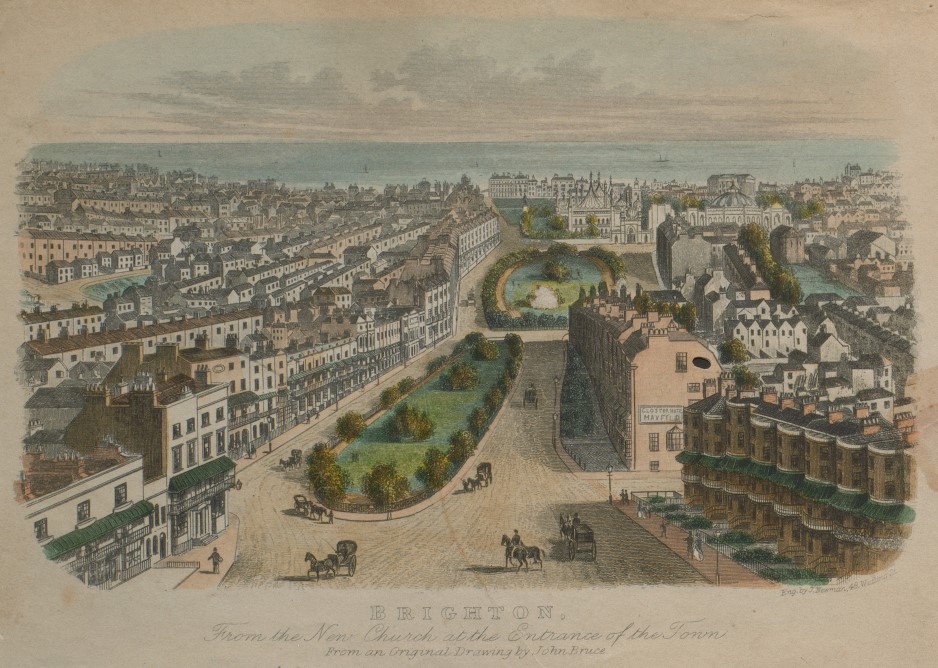
This image of Brighton, which has been dated to around 1835, shows the rapidly developing town which John had left his rural village for. How different, stimulating and perhaps overwhelming it must have felt for him!
The 1841 census places John, aged 19, at Victoria Street, Brighton. His occupation is given as a labourer, like some of his neighbours at the time. Still extant, in the Montpelier / Clifton Hill Conservation Area of Brighton, Victoria Street is rather beautiful. It is likely therefore that John was living on site whilst helping build the street, which was completed between 1837 and 1841. But ‘working for the man’ was just a stepping stone for John.
This tallies with the 1860 testimony of Mr. William Hall, who in a legal case which we will come to later stated that he had known John for about 25 or 30 years, and had done business with him almost since he knew him. William was a proprietor of houses.
Mr. Thomas Austin, a timber merchant, also stated during the same case that by that year he had known John for 15 or 16 years, i.e. since around 1844.
John’s early professional relationships help build a picture of a man who was motivated from a young age to make it in the business of building and selling or leasing property. Whatever his first introduction to the trade was, John’s consistent occupation in adulthood was the provision of timber, slate and flint to Brighton’s many building firms. How John so quickly worked his way up to the role of a supplier is curious. It seems likely that he had the canny idea of getting paid to pay others to build houses which he was then paid to manage as boarding houses and lived in almost rent-free whilst commencing work on the next batch of houses. This would have allowed him to accumulate the capital needed to buy stock and set up as a goods merchant, probably assisted by sureties on loans granted by those he contracted with.
Marriage
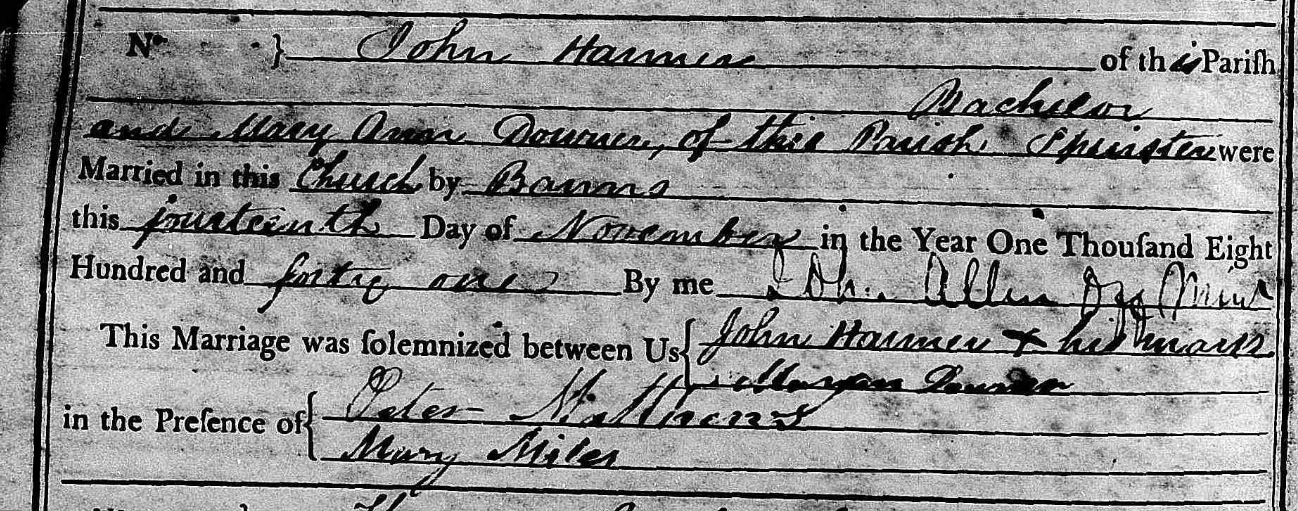
John married Mary Ann Downer at St. Nicholas Church, Brighton on 14th November 1841, giving his name simply as John Harmer. Mary Ann was born in Brighton, in the same year as her husband, so they were only 20 when they wed – and when they did, they wed for life. Their marriage record indicates that Mary Ann was the daughter of a James Downer, but other details of her early life remain to be discovered. I do not know who the witnesses to their marriage were (Peter Matthers and Mary Miles), but they do not appear to be relatives. Mary Ann has signed her own name, whereas John has simply made his mark – ‘X’ – suggesting that he could not yet read or write:
Exactly where the couple lived in the early years of their marriage is unclear, but their first child, Sarah Elizabeth, was born in 1843 at Brighton. Their first son, John, was born in the spring of 1846 at Brighton. A second son, James, was born in the adjacent town of Hove in the winter of 1847. Today Brighton and Hove form one municipial area, but historically the two towns had their own identities. Hove traditionally sought to distance itself from Brighton, with Hoveites considering themselves a cut above the riff-raff of Brighton. There is no reason whatsoever to conclude that John adopted this attitude on a personal level; it is far more likely that he recognised the financial benefits of developing property in Hove and how this could elevate him commercially above his peers in the building industry.
Life in Hove
By 1848 John appears in Folthorp’s street directory at 41 Western Road (Hove) where he was running a lodging house. In those days Western Road’s numbering ran in two sequences, with the Hove part commencing just west of Norfolk Square. Numbers 30 onwards do not appear in the 1845 directory, so the Harmers’ house was probably newly built when they moved in.
The 1851 census describes John Harmer as 29 years old, and a Builder and Timber Merchant. He was living with Mary Ann and their young family; John aged 5, James aged 3, Mary Ann aged 2 (born 1849) and Henry Albert aged 6 months. All the children shared Christian names with some of John’s siblings. John’s 14 year old brother Henry, a plasterer, was also living with them. Their address was still 41 Western Road. Sarah Elizabeth is absent, but I have found her staying at Mill Cottages, Poynings, with Beeding-born Elizabeth Barber nee Temple. Elizabeth, a widow aged just 42, was a laundress. Her deceased husband James was the son of John Barber, John Harmer’s mother’s brother. In short, Sarah Elizabeth was staying with her cousin’s family on her dad’s mum’s side.
Early signs of John’s interest in property development
In September 1852 John acquired 6 Farm Road from a Mr. Gillett. We know this courtesy of a report in the Brighton Gazette of 30th September, which covered the theft by Edward Gillett, the previous owner’s son, of a tap and ball cock from the premises prior to handing the keys over to Richard Spratley, an employee of John’s. John is described as living at Lansdowne Terrace, which includes 41 Western Road.
Taylor’s 1854 street directory places John at newly built 3 Farm Road, and describes him as a builder, and a timber and slate merchant. In the same year Clement Lewer, another Brighton builder with whom John would go on to build several streets including his opus, Wellington Road, was living at no. 10 Farm Road. In 1856’s directory John is living at no. 1, and was again running a lodging house.
