John was born John Lovell Harmer at Heathfield, Sussex, in 1821, and baptised at All Saints Church there on the 17th of April 1822.
He was the son of George Lovell Harmer, a shoemaker (christened on 20th May 1792, at All Saints Church in the neighbouring village of Waldron either as George Lovel or George Lovel Harmer). George was described as ‘baseborn’, which means he was illegitimate, and was the son of an Elizabeth Harmer of Heathfield. No father’s first name is recorded. We can be confident that this George was John’s father via census returns which consistently reference his age, and of course by John’s own baptismal record.
John’s Harmer Grandmother
I was originally thrown off course whilst delving into John’s parentage, by the fantastic Weald project website. This attempts to transcribe all the parish registers pertaining to the various villages in the Sussex weald, and also to form relationships between personages in the form of family trees. The former are extremely useful (although there is missing data), but the latter cannot be taken as authoritative. In this instance, John Harmer’s grandmother is taken to be the daughter of Abraham and Elizabeth Harmer of Waldron, but I no longer consider this to be her line.
I now believe John’s grandmother to be the same Elizabeth Harmer whose will was proven on 30th July 1836. Elizabeth’s will describes her as a spinster, and names her only brother John Harmer, gentleman (for whom our John was most likely named), and George Lovell Harmer, shoemaker of Heathfield, as beneficiaries of her £20 estate. Her burial record states that she was interred on 20th July 1836 at All Saints, Heathfield, and was 73 years old, thus born in 1763. She would therefore have been 29 when she gave birth to John’s father George. Perhaps she spent her confinement at Waldron or was working there as a servant, hence having him baptised there? George consistently gave his place of birth as Heathfield in census returns, implying that Waldron played little part in his life.
Getting back to Elizabeth’s early years; the Heathfield parish registers record the christening of an Elizabeth Harmer on 10th of July 1763, the daughter of William Harmer (circa 1744 – 20th March 1785) and Susannah Harmer née Daws (circa 1740 – 1790). Her parents had married on 16th April 1761 at All Saints Church Heathfield, and had at least five children including Elizabeth, all of whom were baptised at Heathfield. Their firstborn was a son, John Harmer, who was christened on 14th October 1761 (died 1838). Then after Elizabeth came Susanna who was christened on 7th September 1764 and died unmarried in 1836. Their second son William was christened on the 3rd July 1766 and sadly died aged a little under 3 years of age on 6th April 1769. A third son, Joseph, was christened on 23rd July 1769 and died in 1827 (buried at All Saints, Heathfield on 30th July). This certainly tallies with the reference in Elizabeth’s will to John being her only brother by that time.
It is possible that in 1780 when she was 17 years old Elizabeth had a daughter out of wedlock, whom she named Ruth. Ruth (who would be our John Harmer’s aunt) was christened at All Saints Heathfield on 20th February 1780 and went on to have six children by two husbands. Interestingly Ruth’s first child resulted in a bastardy examination which accused William Hasleden, a labourer of Mayfield whom Ruth later married, of being the father. Ruth died at Mayfield in 1815 when she was just 35 years old. I should qualify that the assumption that our Elizabeth Harmer was the same single mother of that name who gave birth to Ruth has been made by The Weald, although she does seem to be a good candidate.
In 1785, five years after Ruth’s birth Elizabeth’s father died, when he was just 41. Her mother remarried in 1773, to a John Dearing, and ten years later had another daughter, Lucy.
John’s Harmer Great-Grandfather
I do not usually pay much mind to Ancestry trees, as with all due respect to their creators they are often populated with errors. However one tree has given me some clues which I would appreciate validation about. It suggests that Elizabeth’s father William was the son of Richard Harmer of Heathfield (1712 – 1792) and his wife Sarah Harmer née Dallaway (1716 – 1781). I have yet to find a baptismal record for William Harmer from which to search backwards, but the commonality of Christian names amongst Richard and Sarah’s presumed children in comparison with William’s on this tree (Joseph, William, John, Elizabeth) could suggest immediate ancestry.
So far the closest I have come to Sarah is a Sarah Dolloway, baptised at Heathfield on 14th Oct 1718, the daughter of John and Susannah Dolloway.
Who was John’s Paternal Grandfather?
Presumably George Lovell Harmer’s father was a Mr. Lovell – possibly a George Lovell as per the contemporary tradition of naming the first born son for his father. In a section of the churchyard at All Saints Church, Heathfield, many Harmer gravestones from the 19th century are to be found, and immediately adjacent to them is the grave of a George Lovell who died in 1837.
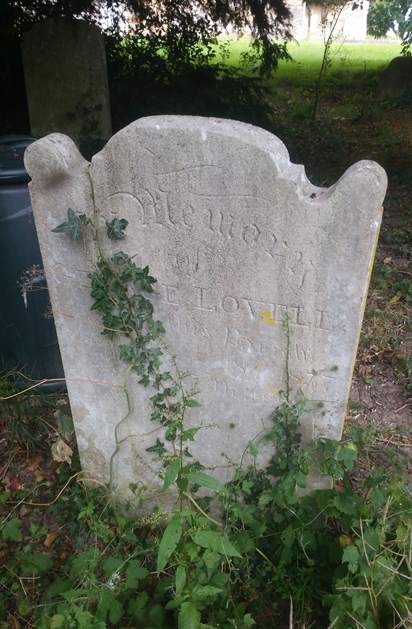
This seems to be the same George who has a burial record in the parish registers for 24th Feb 1837, and who died on 18th Feb. George was aged 73 when he died, so would have been born around 1764, and about 28 years old when George Lovell Harmer was conceived. Indeed, he would likely have grown up knowing Elizabeth, who was just a few months his senior, and at the very least would have seen her at church every week.
George was married at the time of George Lovell Harmer’s birth, having wed Mary Midmer / Midmore of Wadhurst at All Saints Church on 9th April 1787. This marriage may have been forced upon George, as he had sired an illegitimate daughter with Mary in 1786, to whit he was bound over for £150 to acquit the parish of any financial responsibility towards the upkeep of the child. George and Mary only had two subsequent children that we know of; Ann (born 1799) and Henry (1803 – 1864).
George owned a freehold messuage and land at Street End, Heathfield which would have entitled him to vote in 1837 (he appears in the polling register) if he had not passed away before the election. He was a farmer, but his legitimate son Henry was a master shoemaker and sometime publican, having in his youth been apprenticed to John Uckfield of Heathfield, shoemaker, for three years. Could he and George Jnr. have been half brothers, perhaps even apprenticed to the same shoemaker albeit a decade apart? The trade was prevalent amongst this branch of the Lovell family in the mid 19th century, which could imply that George Jnr. was raised knowing his relatives on his father’s side. If his father’s identity was an open secret, George probably knew his paternal cousins and half-brother well. Ironically he would have know them as neighbours anyway.
A 91 year old farmer named George Lovel appears in the 1841 census at the nearby village of Penhurst, where he is living with his son George Jnr. born c. 1791 – perhaps Farmer George was the baby-daddy, and already had a first, legitimate family. But I think the Heathfield George Lovell would be a better bet.
Whoever the father of Elizabeth’s child was, she was not ashamed to give his surname to her baby boy, which suggests that his parentage was no secret in the small Sussex community he was born into.
John’s Parents
John’s mother Elizabeth Barber was born in 1790 at Poynings, and married his father George Lovell Harmer at Brighton in 1814. Why they chose to marry there and not in Heathfield so far remains a mystery. It is possible that George was working as a journeyman shoe salesman for another shoemaker. It is also possible that he had family on his father’s side who had moved to Brighton; I have yet to find out more about a Mr. Lovell, boot and shoemaker, who had a shop in St. James’s Street in 1837 and possibly much earlier.
The Lovell Harmers had nine children including John, and gave them ‘Lovell’ as what we would call a middle name although having two, unhyphenated legal surnames of this nature was not unusual back then. When he grew up our John dropped ‘Lovell’, perhaps to distance himself from any gossip about his father’s illegitimate birth.
George and Elizabeth’s first son, George, was christened at Bexhill three years after their marriage. Whatever their reasons for being at Bexhill, the family were back in George’s home village of Heathfield by 1820 when their first daughter Sarah Elizabeth came along. As we have seen, George inherited a share of £20 when his mother died in 1836. His uncle John Harmer passed away in 1838, when he was 76 (buried 15th of June at All Saints, Heathfield), and by 1841’s tithe apportionment and census we find George (45), Elizabeth (45), and their children Mary Ann (14), James (10), Susan (8), Zilpah (6) and Henry (3) living in a cottage at Quarry Brook, Heathfield.
George is listed as a tenant of the land, which was owned by the executors of his uncle John. By 1842 George appears in the Mayfield district polling register, his eligibility to vote being based upon his freehold property at Quarry Brook, so he must have inherited or purchased the cottage. There were only three cottages at Quarry Brook at this time, and it provided a very isolated existence. Almost all of the Lovell Harmers’ immediate neighbours were farmers or agricultural labourers, with the exception of the village blacksmith, a schoolmistress, and a miller. Ambitious, and craving opportunities which rural Heathfield could not provide, John moved to Brighton to start a new life when he was around 17 years old. This may have been helped a little by his father’s inheritance, although John became self-sufficient very quickly.
We know for sure that by the time of the 1841 census, when he was 19, John was living in Brighton, as were his siblings, Sarah Elizabeth, and Martha. John’s brother George had only moved half a mile or so up the road, and was living at Alley, now Halley Road.
Within a few years a pattern of economic migration towards the developing seaside resort is observable, with John’s parents and eventually all of his siblings following suit.
I am very grateful to my friend and fellow local historian Renia Simmonds for helping me understand and for researching Heathfield tithe apportionments during the development of this article and for helping me join the dots with some family connections.
