This is an article in progress, as there is no central data source from which to ascertain which houses in Brighton and Hove were built by whom. Therefore I am adding information about ‘The Houses That Jack Built’ as and when I find it.
When John arrived in Brighton from Heathfield the town’s population was around 46000. By 1851 this had boomed to 65569. The coming of the railways in 1841 increased Brighton’s popularity and swelled the working class infrastructure which kept the town going. The result was that throughout the following decades many thousands of houses were springing up in Brighton and Hove. These ranged from spacious villas, intended for the middle to upper classes, to cramped terraced accommodation for manual labourers and the families of the many men who worked for London, Brighton and South Coast Railways company.
Hundreds of builders were forced to file for bankruptcy, as competition for building contracts and the provision of bricks, timber and other supplies saturated the trade. John, however, always seemed to stay on top. A major advantage which he had over his peers was that he was a supplier of flint and timber, as well as being a builder in his own right.
The Wellington Estate
This was a large-scale project which John was the projector of, and remained involved with, from 1852 to 1860. You can read more about it here.
Lewes Road
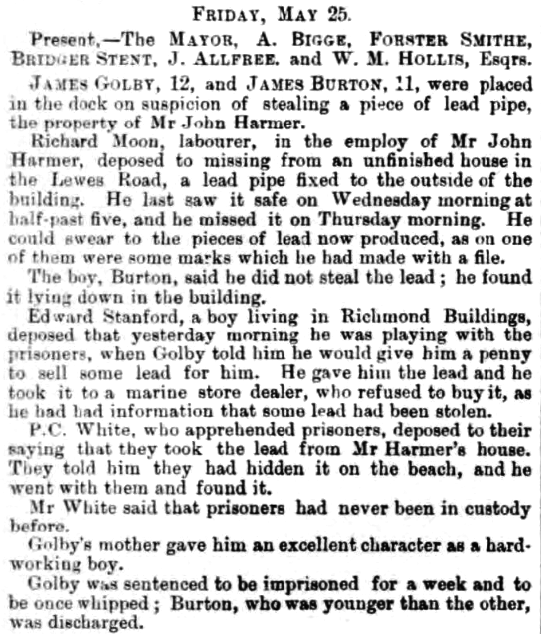
During the late 1850s and throughout the 1860s the previously rural road to Lewes was extensively developed for largely working class housing. Lewes Road is adjacent to the Wellington Estate, and John ran the Race Hill Inn at 1 Lewes Road from 1856 to 1859. We don’t know which houses John built on Lewes Road, but the article below from May 1860 indicates that he was still actively erecting at least one house there in that year. The most likely candidates are 18 and 19 Lewes Road, which are first listed in the census and street directory for 1861, or the area further north comprising number 19 to 28 which were also occupied for the first time in that year. As number 18 was unoccupied in April 1861, perhaps this was the house from which two naughty boys stole a lead pipe!
Houses in Hove
I am grateful to my friend and fellow local historian Renia Simmonds for unearthing this record, which shows that John was tendering for the building of new roads upon the Wick Estate, between 1848 and March 1850:
‘Roads proposed to be built by Sir Isaac Lyon Goldsmid bart.
Correspondence, tenders, notices, draft vestry minutes, contract and draft justices’ highway certificate concerning road 615 ‘north from Upper Brunswick Place to The Wick and 845′ east from The Wick to the Brighton boundary; tenders from Henry Pescott (successful), John Harmer, John Clayton, S North and Moses Shallcross.’
Lansdowne Place
Renia has also located this record pertaining to 59 Landsdowne Place, Hove, which shows that although John’s original tender to build whole roads was not successful, he built at least one house for Goldsmid on the Wick Estate:
‘Deeds and correspondence [1783 – 1887] between Sir Isaac Lyon Goldsmid, John Harmer, Samuel Levison, Fredk.Wm. Headland, Joseph Valentine Smedley, Richard Stuart Lane, C.W. Pringle, Charles Taylor Cheesman, John William Wells AND J.L. O’Beirne concerning Somerset House or 59, Lansdowne Place, Hove (originally part of Wick Farm).’
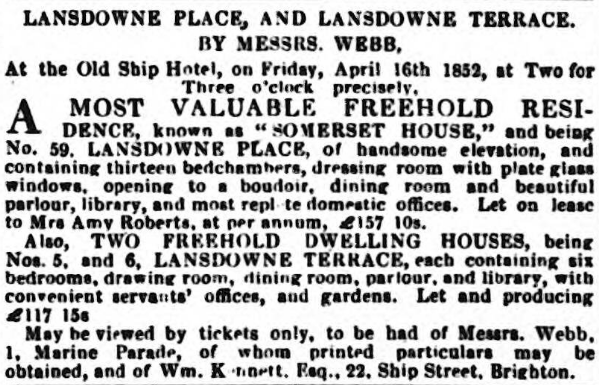
I haven’t had sight of the actual documents, which are held by the London Metropolitan Archives, but I have found a record of the house being sold in 1852. At the time it was let out for a whopping £117 15s per annum. In August 1854 the Brighton Gazette recorded in its ‘Fashionable Arrivals’ column that ‘Sir Thomas and Lady Roberts are staying with their sister, Miss Amy Roberts, Somerset House, 61 Lansdowne Place’.
Adelaide Crescent and Terrace
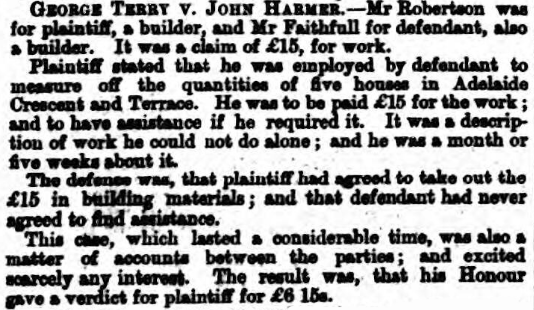
We know from the following article which appeared in the Brighton Gazette that John was involved with the construction of at least five houses in Adelaide Crescent and Terrace in 1855. He had had probably begun work on them much earlier, as these mansion houses on the Brighton and Hove border are very large and grand.