This exploit of John’s involves a pub which still sits in the heart of John’s Wellington Estate near Lewes Road, Brighton.
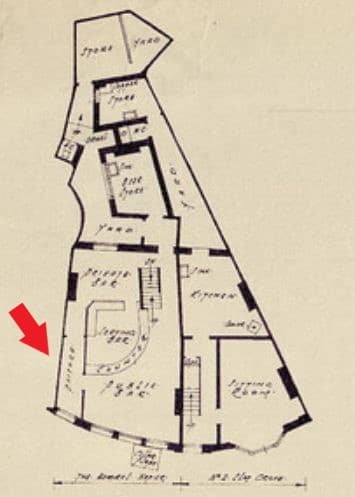
The Admiral Napier opened as a licenced premises in 1854, although it had been a beer house prior to this, run by a George Bowles. It was named for the famous Royal Navy officer Charles Napier, but in homage as opposed to remembrance – Napier did not pass away until 1860. Bowles believed that ‘Napier’ was a Scottish word meaning ‘unrivalled’, and this was how he envisaged his inn. The building itself was demolished and rebuilt in 1934. Then as now it spans three storeys plus the original cellar, and occupies a peculiar corner position, at what was in the 1850s known as 60 (or 6?) Bright’s Place but is now 2 – 6 Elm Grove. The picture below is the oldest which I have been able to source of how The Admiral Napier would have looked in John Harmer’s day. You can also view the original layout of the old pub here.
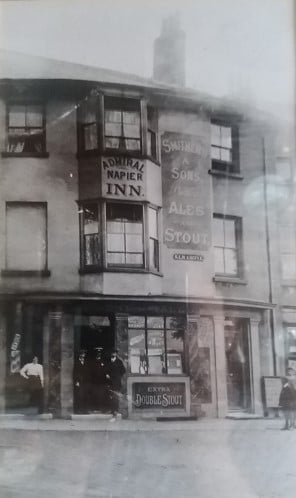
At about half past midnight on Sunday morning 21st April 1860 John called on an acquaintance who lived in a house on the Wellington Estate, ‘in the north of the town’ as it was quaintly referred to then. The purpose of this visit was apparently to pay back some money which a person there had loaned to one of John’s ‘boys’. As his children were far too young to be borrowing money, this must refer to an employee of John’s, probably a builder. That’s if it was even true!
Whatever John’s reasons for being at the bottom of Elm Grove (or the Race Hill Road as it then known), he was “got at”, in his words by two men, one of whom was named James Kelly and worked at the railway. James Kelly was a 34 year old coach smith, living at Islingword Road which is adjacent to the Admiral Napier, and by April 1861 at 28 Howard Road – which is two roads up from the inn as one is heading up Elm Grove. Stockport-born Kelly lived with his Lancastrian wife and four young children. Many of Kelly’s immediate neighbours were also employed at the railway works.
Now, what is more likely than John being pressganged into breaking and entering The Admiral Napier is that he simply bumped into two friends or drinking companions who were on their way home from a public house in the town centre which ‘chucked out’ at midnight. The scene at The Admiral Napier played out at around 1am.
John’s turn of phrase here, that he was ‘got at’ is interesting. I wonder if his reputation for demanding alcohol late at night encouraged others to egg him on, and get him into even more trouble. According to John, the two men came over to his side of Elm Grove, calling to him to “Come across to Nye’s, there’s a light there.” This implies that they saw John coming out of Wellington Road, from where there is still a good view of the Admiral Napier pub. John told the court that he thought there was a light, but when they all crossed over he saw that he had mistaken the reflection of light on the glass for an oil lamp inside. This is rather curious, as there were not yet any streetlamps in the vicinity, and the moon was new that night according to almanacs from the time.
Not deterred, John (or one of his comrades) commenced banging on the door, and kicking it according to James Nye, the landlord of a little under two months who had been asleep upstairs. Hearing the hullaballoo, Nye jumped out of bed. Mrs. Nye, also by now awake, was afeared that the house was on fire or that someone had been taken sick. Nye looked out the window, saw the three persons, and told them he would not come down. John’s response was “If you do not come down I will break your bloody door down!”. Nye told John it would be a bad job for John if he did, and got back into bed.
Seconds later Nye heard the sound of the door being kicked in, and splintering. After slipping on some clothes and getting a candle lit he went downstairs to find John and Kelly standing on each side of the passage. This was a corridor to the far left of the building, which had a street entrance and connected the public bar with the private or ‘saloon’ bar at the back. “A bottle of champagne!” John demanded, to which Nye replied “You shall not have it.” “A dozen then!” was John’s response, “We will [have it] or we won’t go out!” When Nye demanded that they leave, either John or Kelly blew his candle out. Finally Nye started shouting “Police! Thieves” at the top of his voice, and John, Kelly and their unnamed companion gave up on their mission and vanished into the night.
John continued wandering around the Wellington Estate, eventually going home to East Street in the middle of town around 6am, where he changed his clothes and went out again soon after. On Grand Parade he bumped into Nye (we should remember that the population of Brighton was much smaller then than it is now) and held out his hand as usual. But Nye, still livid about the events of the night before, refused to shake hands and told John that he wanted nothing more to do with him. In fact, he was on his way to the magistrates court to gain a summons against John. John’s reaction to this was utter astonishment, and some quite hurt feelings! ‘He never thought [Nye] would be so mad-brained as to bear any grudge for what had been done. People sometimes called him “mad-brained Jack Harmer;” but he never did anything like that.’ John also claimed that ‘he had never in his life had a greater feeling upon him that he did that morning,’ and that he was ‘more agitated with this case than ever he was with anything in his life’.
This was part of an apology to the court for his behaviour at the hearing which came to pass on Thursday April 25th at the Brighton Borough Bench. Reading between the lines it was also a tacit way of John acknowledging the mania – or ‘excitement’ which such occasions elicited in him, and the sympathy with which he knew the court (or at least certain key officers there) regularly regarded it. For this particular court appearance was one of John’s finest, at least in terms of entertainment value.
John in Court – again!
James Kelly failed to attend court, although John claimed to have been with him that very morning. John himself was evidently still drunk from the night before, and had no solicitor. Perhaps as a means of rehydrating himself, he had brought an orange with him into the court room, which he kept on a chair next to him, periodically turning his back to the bench to ‘wet his whistle’ to the amusement of the public gallery.
On the subject of the champagne, John remarked to Nye: “And I wanted some champagne, did I? I suppose if you had any you would have let us have it. Was that not the reason you would not let us in, eh?!” This filled the courtroom with deafening laughter, and when it subsided John turned mischievously to the highly respected public prosecutor Alderman Charles Lamb and remarked “Why, I have never had a half-dozen or a dozen like my legal friend here got of me and not paid for them yet!” [‘roars of laughter during which defendant sucked the orange as before’]. Lamb was subsequently forced to admit that John always stood his round in the pub, including the Race Hill Inn when he was landlord there! Perhaps all the more generously so if he was socialising with this very prominent citizen, who held much sway in public affairs.
John persisted in asking Nye seemingly irrelevant questions about every house he had ever lived in, and tied him up in word games about the simplest of statements with increasing belligerence until Lieut-Colonel Fawcett who was sitting at the bench demanded that John be removed from court. This sent John into a frenzy of cries of “Commit me then! Do it!”. As he was led to the cells John turned and shook his fist at Fawcett, shouting “I tell you what, sir. You are making a mistake with the man you are dealing with!” When someone at the attorneys’ table observed that John had better come back and conduct his case properly, John demanded to know if he was dealing with “a lot of a shoemakers or a bench of Honourable Gentlemen.” This was too much for the spectators and the room descended into chaos. The officials withdrew to discuss what to do next, and half an hour later John was allowed to come back. He refused to come back upstairs for a good ten minutes however, making the crowd wait with baited breath before finally reappearing replete with his orange. After apologising for his ‘shoemakers’ remark John continued in much the same vein as he had before, asking Nye impossible questions such as the precise minute that he had kicked the door in, who blew the candle out, and so on until the Mayor had had enough.
The outcome
Of course, John was ultimately found guilty, but he even managed to turn his sentencing into a burlesque performance. Mad Jack, for unfathomable reasons, began goading the Mayor to give him a custodial sentence:
‘Will you allow him to do it? […] I have done, gentlemen. I leave myself entirely in your hands. You can do with me just as you please. (At this point the defendant burst suddenly into a laugh, which was joined in by almost everyone in the court; and as he sat down he shouted out “It is the first time I was ever locked up for something of this kind!”).’
The Mayor immediately decided that John and Kelly must pay 5 shillings each, or spend a week in Lewes Prison:
‘Defendant (very excitedly) : I will have the week’s imprisonment, I will. I won’t pay the fine.
Several of the bystanders expostulated with him; but he would not listen to them, and gave himself into the custody of one of the officers. He said […] if any gentleman paid the money for him it would be of no use, for he would go a week and bid defiance to the world. He would make the magistrates remember their decision.
As he walked from court, defendant made another eager attack upon the orange.’
The fine was later paid, either by his wife Mary Ann or by a friend or ‘fan’ who had the sympathetic ear of the Mayor, and John was released the same day.
What was the backstory between John Harmer and James Nye?
There are a few clues in the trial reportage which indicate that John and Nye were involved in some kind of financial business with each other prior to the door-smashing incident. For example, when Nye started to holler for the police (who never turned up), John “knew that he was doing it for the purposes of extorting money”. John also claimed that the reason he was so upset with Nye for having taken the matter to court was that he had turned on him after causing him within the past twelve months to spend £800 of his children’s money.
What could that mean? It couldn’t possibly be champagne – even John wouldn’t have spent that much in one year on fizz. It is possible that Nye had become involved with some financing of John’s building developments, and had not paid on time for building work he commissioned. We know that another Brighton publican who John had befriended through his fondness for public houses, Walter Craven Bennett who kept The Carpenters Arms in West Street, was a small time property developer and had invested with John regarding the construction of 8 Wellington Road. The £800 could potentially represent the cost of constructing between four and six of the smaller houses in the Elm Grove area which John was working on prior to the scuffle. Would it not make sense for Nye to invest in property which would be occupied by people who would drink in his inn?
Certainly, as John established during his cross-examination of Nye, the two men had known each other for 19 years (i.e. since around 1841). Although John didn’t mention this, I have discovered that Nye had convened a cruel dog fight at Old Shoreham back in 1857, involving his own bull dog and the illegal sale of liquor. One of the attendees was Clement Lewer, who had built many houses with John including his own on Wellington Road – where Lewer was still living in April 1860. It may even have been Lewer who John had been visiting that night. Nye also ran The Wick Inn for many years, which would have been John’s local pub when he lived in Hove. This would account for the relatively small sums of money – £4 here or there – which Nye admitted he had loaned John in the past and which he had always paid back – they were most likely bar tabs! It was common in the 1860s for foremen to pay wages to labourers in part by putting money behind the bar in their local – where it would only get spent anyway. Where a landlord allowed a monthly account, this worked out well for cashflow purposes whilst waiting for income from investors and offsetting the cost of bricks and other materials against wages.
One newspaper report about the Admiral Napier debacle refers to John shouting up to ‘Old Will’ to come downstairs and let him in. I don’t know how Will could be short for James, but the Victorians were very fond of nicknames and this certainly implies a degree of familiarity. James was about ten years older than John, being recorded as 50 years of age in the 1861 census.
A little more about James Nye
As a side note, James Nye had a subsequent disturbance at the Admiral Napier to deal with, on New Year’s Eve 1861. It seems that his good lady wife Charlotte was rather fond of the grog, and could get very nasty when ‘in drink’. She also had a habit of randomly deciding that she wanted to close the pub at any time of day or night she chose, and throwing pots and decanters at James’s head if he protested. On this occasion a police officer witnessed Charlotte scratch James on the face, and heard James tell him that he was afraid for his life. However the officer was powerless to arrest her – some gender inequality was going on there for sure! Charlotte was finally taken into custody when she bolted from the pub and made a noisy scene in the street, screaming “Murder!”.
The Brighton Guardian of 1st January 1862 reported that Charlotte Nye, 49, landlady of the Admiral Napier Inn, Elm Grove, was charged with being drunk and disorderly in her own house, and was sent to prison, without hard labour, for seven days. Charlotte died on 21st August 1862 at nearby 56 Cobden Road. James’s feelings about her passing are unrecorded.
Sources quoted throughout this article include the Brighton Guardian of 2nd May 1860, the Surrey Gazette of 1st May 1860 and the Brighton Gazette of 2nd April 1857, 2nd of January 1862, and 28th August 1862.
